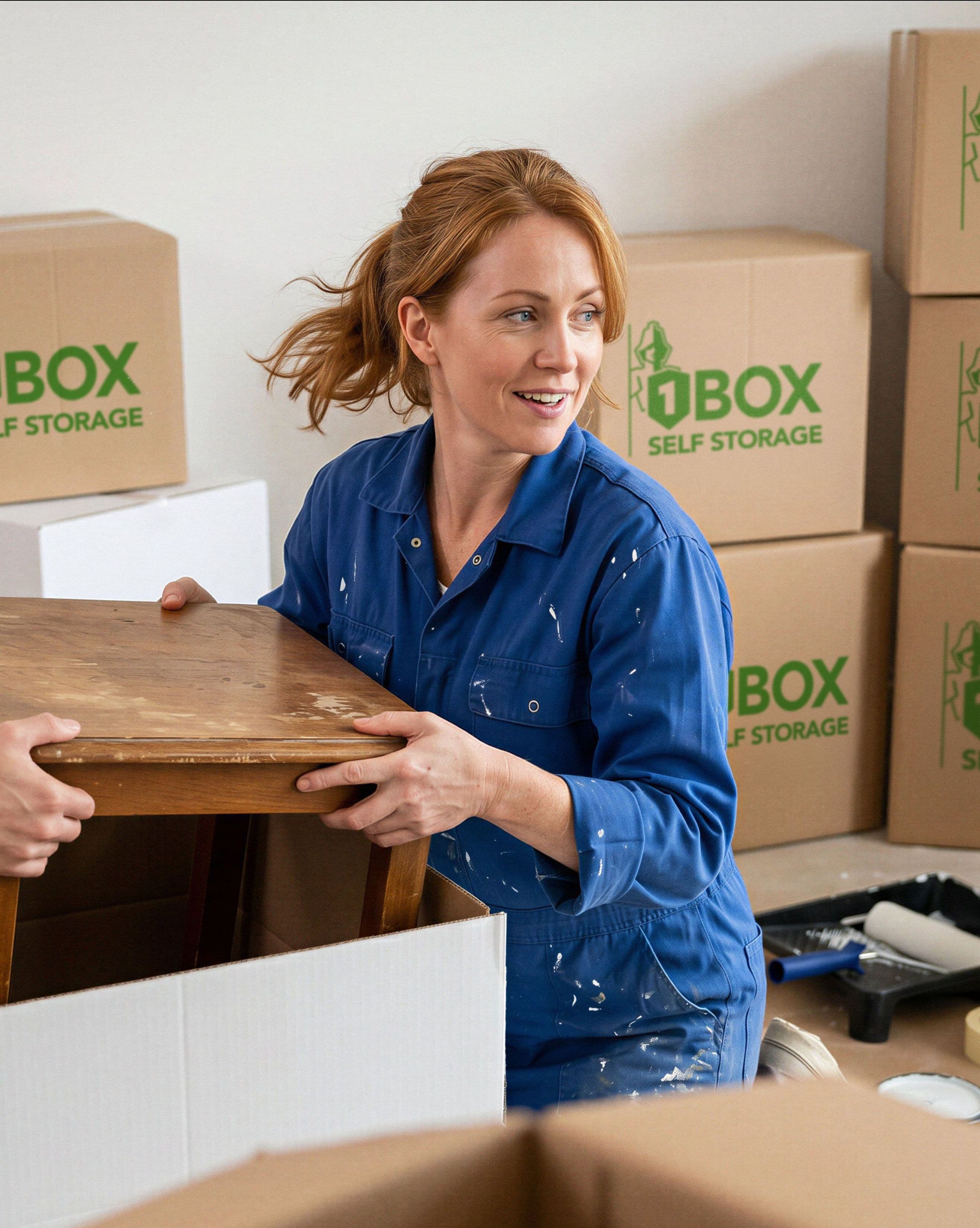
How much storage space do I need? That's probably one of the first questions you ask yourself when you want to store your belongings. You want to have enough space for your furniture, boxes, or business inventory, without unnecessarily renting a large unit. By packing and stacking smartly, you can often fit more into a storage unit than you think.
A good estimate starts with an overview of your belongings. Go through your home or business room by room and write down what you want to store. For example, consider:
• Furniture, such as a sofa, bed, dining table, and wardrobe
• Moving boxes with clothes, books, crockery, and other loose items
• Seasonal items, such as garden furniture, Christmas decorations, and winter sports equipment
• Bicycles, tools, and sports equipment
• Business items, such as webshop inventory, archives, and office furniture
Also note the dimensions of large furniture and see what you can disassemble. A disassembled bed, for example, takes up much less space than a complete bed frame. Also consider which items you might need to access during storage.


| Type of space or items | Indicative space | Example |
|---|---|---|
| Small household inventory | 4 to 6 m² | Studio or 1-room apartment: bed, wardrobe, sofa, and table |
| Medium household inventory | 8 to 10 m² | 2-room apartment: full household inventory |
| Large household inventory | 12 to 15 m² | 3-room house or family with a lot of furniture |
| House full of inventory | 18 to 25 m² | House with 4 or more rooms |
| Moving boxes | 1 to 2 m² per 20 boxes | Loose items, clothes, and books |
| A car | 10 to 12 m² | Including walking space around the car |
| Motorcycle or scooter | 2 to 3 m² | One vehicle with accessories |
| Bicycles | 1 to 2 m² | Two to three bicycles |
| Office inventory | 4 to 6 m² | One desk, cupboard, and chairs |
These are general guidelines; they do not guarantee that every household inventory will fit within these areas. Large furniture, fragile items, and a walkway may require extra space. Available unit sizes vary by location.
Do you want to store a car? Then look at the options for a garage box or outdoor unit. Check the length, width, clearance height, and space for getting in and out beforehand.
How much business storage space you need also depends on how often you need to access your items. Archives that you use infrequently can be stored compactly. For webshop inventory that you need daily, it's better to leave space to easily retrieve products.
Then, measure the floor area of your shelving or furniture and draw out the layout. Take into account doors, protruding parts, and sufficient space to access items. Do you expect your inventory to grow? Factor in that expansion immediately.
View the options for archive storage, webshop storage, and business storage.

| What do you want to store? | How to estimate the required space |
|---|---|
| Archives and binders | Count your binders or archive boxes and calculate how many shelving units you need. For example, a 1-meter shelf can fit approximately 12 binders, each 8 cm wide. With five usable shelves, that's about 60 binders per shelving unit. |
| Webshop inventory | Measure your inventory in boxes or bins and determine how many you can fit per shelf. Do you have 40 bins, and four fit on one shelf? Then you need ten shelves, for example, divided over two shelving units with five levels. |
| Office inventory | Use 4–6 m² per workstation as an initial guideline for a desk, cabinet, chairs, and boxes. Furniture that you can disassemble can reduce the required space. |
With a clever layout, you utilize the space better and can find your belongings more easily. We are happy to give you some tips.
1. Choose sturdy boxes of the same size. These can be stacked neatly, with less unused space in between.
2. Disassemble large furniture. Store screws and other small parts in a bag with the furniture.
3. Place heavy items at the bottom. Put lighter boxes on top and consider the weight capacity of the packaging.
4. Utilize space within furniture. Use empty drawers and cabinets for smaller, well-packed items.
5. Work upwards. Stack stably and place suitable components, such as loose shelves, upright.
6. Keep a clear path to items you need. Place frequently used items at the front and label your boxes on the visible side.

When choosing storage space, you will encounter both square meters and cubic meters:
- m² is the floor area: the length x width of the storage unit
- m³ is the volume: the floor area x the height of the storage unit
A calculation example: a unit 2 meters long and 3 meters wide has a floor area of 6 m². If that unit is 2.5 meters high? Then its volume is 15 m³.
The height in this example is only intended to explain the calculation. Check the actual height of the unit you wish to rent. By stacking boxes and suitable items, you also utilize the height. This way, you can store a lot in a relatively small floor area. Please note that you cannot safely stack all items up to the ceiling.
Sometimes a slightly larger unit makes storing and retrieving your belongings much easier. For example, if:
• You regularly want to pick something up and need to be able to walk past your furniture or boxes.
• You want to arrange your belongings neatly, without stacking everything on top of each other.
• You are renting for a longer period and want to keep space around your items for accessibility and ventilation.
So, don't just check if everything fits, but also if the layout remains convenient during the rental period.
With an overview of your belongings and a clever layout, it becomes easier to choose suitable storage space.
Are you unsure between two sizes? Contact us. We are happy to help you decide.
Make a list of your furniture, boxes, and other items. Measure large objects and see what you can disassemble or stack. Keep extra space free if you want to be able to access your belongings in between.
For a studio or one-room apartment, you can use approximately 4–6 m² as a first guideline. For a two-room apartment, it's about 8–10 m². The actual space depends on your furniture, the number of boxes, and how compactly you can store everything.
For a larger household inventory, you can take approximately 12–15 m² as a starting point. For a spacious single-family home with multiple bedrooms and many items, this can increase to 18–25 m² or more. Therefore, always make an inventory of what will actually be stored.
Square meters indicate the floor area of a unit. Cubic meters indicate the total volume, including height. You calculate the volume by multiplying the floor area by the height: for example, a 6 m² unit with a height of 2.5 meters has a volume of 15 m³.
That depends on the size of the boxes and how high you can safely stack them. As a calculation example: ten boxes of 60 × 40 cm next to each other use a total of 2.4 m² of floor area. With four layers, that's 40 boxes. Whether this arrangement actually fits depends on the shape of the unit, access, and the weight capacity of the boxes.